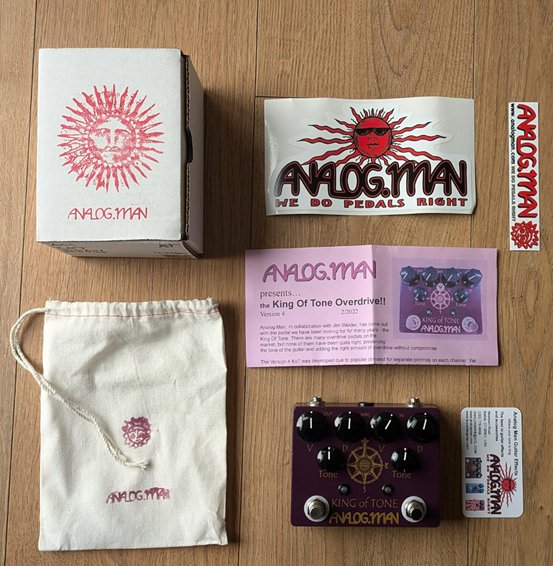
The Analog Man King of Tone is widely regarded as one of the most respected boutique overdrive pedals ever built. Rather than delivering aggressive distortion, the pedal focuses on transparency, dynamics and touch sensitivity. Its dual overdrive design allows guitarists to stack two independent gain stages, making it exceptionally versatile for blues players who rely on picking dynamics and guitar volume control to shape their tone.
Manufacturer and Model Background
Analog Man is the boutique pedal company founded by Mike Piera in the United States. Since the 1990s, Analog Man has built a reputation for carefully crafted effects inspired by classic vintage circuits. Many of the company's pedals are handmade in small batches and are known for their reliability, musical response and attention to detail.
The King of Tone was introduced in the early 2000s and was designed as a refined interpretation of the classic Marshall Bluesbreaker pedal circuit from the early 1990s. Instead of offering a single overdrive stage, the King of Tone combines two independent circuits in one enclosure. Each side can be configured internally to function as an overdrive, boost or distortion.
Because of its sound quality and limited production capacity, the King of Tone quickly developed a legendary reputation. Waiting lists for new units have historically stretched to several years, making it one of the most sought-after boutique pedals in the guitar world.
Today the pedal is still produced in small quantities in the United States and remains highly respected among professional guitarists.
Why This Pedal Matters in Blues
Blues guitar tone often depends less on heavy distortion and more on dynamics and interaction with the amplifier. The King of Tone excels in this area because it preserves the natural character of the guitar and amp while adding warmth, sustain and subtle compression.
Instead of dramatically changing the sound, it enhances the natural breakup of a tube amplifier. This makes it ideal for blues players who want a transparent push rather than a colored overdrive.
The pedal has become a favorite among blues and blues-rock players who rely on expressive playing, touch sensitivity and gradual gain stacking.
What Respected Blues Guitarists Did With It
Several respected blues and blues-influenced guitarists have used the King of Tone in their rigs.
John Mayer has been one of the most visible users of the pedal. During many touring periods, the King of Tone has been a key component of his pedalboard. Mayer often uses the pedal to push Fender-style amplifiers into smooth blues breakup while maintaining clarity and articulation.
Joe Bonamassa has also incorporated Bluesbreaker-style overdrives into his rigs, highlighting the musical value of low-gain transparent overdrive circuits similar to the King of Tone.
Many modern blues players appreciate the pedal because it allows them to move from clean rhythm tones to singing lead sounds simply by adjusting their picking intensity or guitar volume knob.
Sound Profile
The King of Tone is known for its transparent and dynamic response.
The low end remains tight and controlled, allowing Stratocasters and Telecasters to retain their clarity. The midrange has a warm, slightly sweet character that helps blues lead lines sit naturally in a mix without becoming nasal or overly compressed.
The high end remains open and glassy, especially when paired with Fender-style amplifiers. This makes it possible to achieve the classic Texas blues bite associated with Stratocasters and tube combos.
One of the most distinctive characteristics of the pedal is its touch sensitivity. The gain responds strongly to picking dynamics, allowing a guitarist to move from clean tones to expressive breakup simply by changing attack strength.
Stacking both channels creates a richer, more saturated tone that still maintains definition and musicality.
What Makes It Special
The King of Tone stands out because of its circuit design and philosophy.
Each side of the pedal is effectively a refined Bluesbreaker-style circuit, but with improvements that enhance clarity and flexibility. The internal switches allow each side to be configured as a clean boost, overdrive or distortion.
This means the pedal can serve multiple roles on a pedalboard. Players often use one side as a low-gain boost for rhythm playing and the other side as a higher gain stage for solos. When both sides are stacked, the pedal produces a thick yet articulate overdrive that still reacts naturally with tube amplifiers.
Build quality is another major factor. Analog Man pedals are assembled with carefully selected components and are designed for long-term reliability.
Why Gerbman Uses It
For a blues guitarist like Gerbman, the King of Tone fits perfectly into a tone philosophy built around expressive playing and vintage amplifier interaction.
Gerbman's core sound relies on Stratocasters and Fender-style amplifiers. The King of Tone complements this setup by pushing the amp into warm blues breakup while preserving the natural character of the guitar.
On a pedalboard it can serve multiple functions. One side can be used as a subtle boost to add presence and clarity to rhythm playing. The other side can provide additional gain and sustain for lead passages. When both channels are stacked, the pedal delivers a thicker blues-rock tone suitable for more intense solos while still maintaining articulation and dynamic control.
This versatility makes the King of Tone one of the most valuable tone-shaping tools on a modern blues pedalboard.
Rarity and Availability
The King of Tone is considered somewhat rare. Because Analog Man builds the pedal in limited quantities, the official waiting list has historically been extremely long. In many periods, new customers have had to wait several years for delivery.
As a result, the pedal is highly sought after on the second-hand market. Used units often sell for significantly higher prices than the original retail price.
Collectors and professional musicians continue to value the pedal for both its tone and its boutique reputation.
Variants and Alternatives
A single-channel version of the King of Tone that offers similar tone characteristics in a smaller enclosure.
A collaboration between Analog Man and MXR designed to make the circuit more widely available.
Pedals such as the JHS Morning Glory and the Wampler Pantheon are also inspired by Bluesbreaker-style circuits and offer similar transparent overdrive characteristics.
The original Marshall Bluesbreaker pedal from the early 1990s remains the historical foundation of this circuit style.